Know what your startup equity is really worth — and what to do with it.
Got shares in a tech startup for sale? Value your stake, understand dilution and tax, and prepare to turn it into cash — with plain-English, sourced guides and free tools for founders and employees across the US and Europe. No jargon, no sales pitch — we help you do your homework.
Considering selling? Explore your options →
From grant to exercise to a future sale — understand the whole picture.
Just getting oriented? Start with the free equity starter kit — glossary + the letter that unlocks your paperwork.
Company names are referenced for information only. PrivateTechShares is not affiliated with or endorsed by them.
Make sense of the private-company part of your net worth
Most people with startup equity have no clear picture of what they hold, what it's worth, or what to do before a liquidity event. These tools and guides give you that picture — and the steps to act on it — in plain English, with the sources shown.
What you actually hold
Work out a realistic range for what your shares or options are worth today — from your last round, share count and what you actually hold. Free, no sign-up.
Free estimatorWhat it's really worth
What it costs to exercise, how dilution changes your slice, and how a sale is taxed in your country — the numbers that decide your net outcome.
Guides & calculatorsWhat you can do with it
Vesting, ROFR, board approval, transfer restrictions — the things that decide whether, and how, you can turn equity into cash before an exit.
ReadinessHow to prepare — and turn it into cash
The document checklist, the letter that pulls your paperwork, and the questions to take to your company, lawyer and accountant — the homework that turns your numbers into a decision you can defend. It's in the toolkit.
You stay in controlWant it done on your exact numbers? The Equity Position Report runs the whole picture — worth, exercise cost, dilution, tax and a step-by-step plan — on your own grant.
Understand what you've built
- ✓Value your stake — a realistic range, adjusted for common vs preferred, dilution and tax.
- ✓Prepare a sale properly — ROFR, approvals and the paperwork, step by step.
Make the right call on your options
- ✓What it costs to exercise — strike, tax and the AMT trap, plus the ~90-day leaver deadline.
- ✓Can you even sell? — vesting, ROFR and board approval, in plain English.
What's your stake worth?
A rough guide in ten seconds. It prices off your last round, then adjusts for what you actually hold — common shares are worth less than the preferred shares investors bought — and for how liquid the company is. You get a realistic range, not a single number.
Hold virtual or phantom units (e.g. German VSOP, some ESOPs)? Those are usually cash-settled and can't be sold on a secondary — see the country guides.
An estimate only — not a valuation, offer or advice. Real price depends on the company, the round, demand and any restrictions on your shares. Tax on the sale (and on exercising options) isn't included.
The assessment every shareholder should do
Before any decision you can't undo — exercising, holding or selling — you owe yourself a proper assessment: what you actually hold, what it's realistically worth, the restrictions that apply, and the tax. The toolkit is that assessment, structured — an A–Z deal map with clear STOP boxes that show exactly where a lawyer, tax adviser or notary takes over, plus the explainers, drafts and ready-to-send messages that turn a vague sense of your equity into a decision you can stand behind, for the US and Europe. Built from lived experience of the process — the judgment calls and the traps, not definitions you could look up.
- The private-sale journey, start to finish
- What really decides what your equity is worth
- A plain-English equity glossary
- Your first company-request letter, ready to send
- Know exactly what to do next. An 8-phase A–Z deal map with clear STOP points for lawyer, tax or notary help.
- Know what the sale could actually put in your pocket. A live calculator for net proceeds, offer comparison and the target sale price.
- Run the deal without starting from scratch. A Deal Room control panel, readiness audit, company-side drafts and 11 ready-to-send messages.
- Handle the US-specific traps. ISO/NSO, AMT, QSBS and the exercise & tax questions to take to your adviser.
- Know exactly what to do next. An 8-phase A–Z process with clear professional STOP points.
- Know what you may actually net. Model discount, exercise cost, fees, tax assumptions and competing offers.
- Run the sale from one place. A Deal Room control panel, readiness checks, editable documents and ready-to-send messages.
- Navigate the country-specific mechanics. Transfer & tax playbooks for Germany, UK, France, Spain, Italy, Netherlands and Poland.
An AI prompt can give you an answer. Preparation gives you a position.
We work through the documents, tax detail and process so you understand what you own, what it may be worth and what comes next. We don't introduce buyers or hold funds — we get you prepared to act.
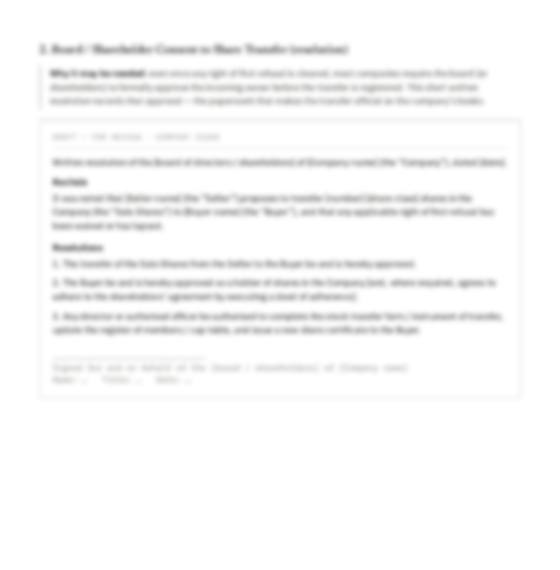
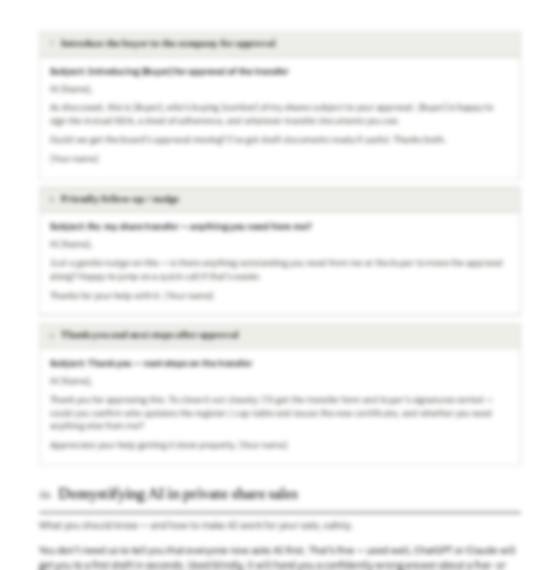
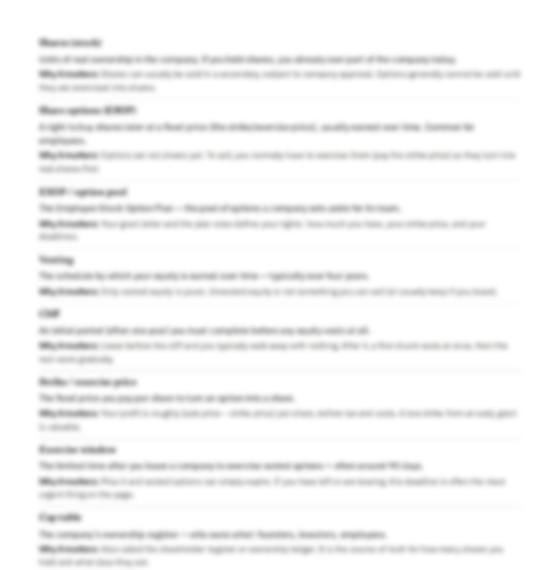
Real sample pages from the report and toolkit — your one-page position, your conversation pack, and ready-to-use documents.
These are educational guides and starting-point drafts, not legal or tax advice. Every document is written in plain English to adapt and have reviewed by a qualified lawyer before anyone relies on it. Laws and taxes vary by country — always confirm your own position locally.
Straight, sourced, and on your side
PrivateTechShares is an information and tools resource for people who hold private-company equity. We help you understand and prepare — we don't hold your shares, and we don't sell them for you.
Education & tools — not advice
Plain-English guides and estimates to help you think clearly. Nothing here is investment, legal or tax advice; take professional advice before you act.
Sources shown
Tax rates, valuations and rules are cited and dated. Things change — we show where a number came from so you can check the current position.
Free where it matters
The estimator, the calculators and the country guides are free, with no sign-up. The toolkit is there when you want the full, prepared version.
You stay in control
Whatever you decide — exercise, hold, or sell later — is yours. ROFR, board approval, price and paperwork stay entirely with you.
Your data, minimised
GDPR from day one. We don't sell your data, and we only ask for what a tool actually needs. Privacy.
Thinking of selling? Start here.
For founders, co-founders and employees with options (ESOP) — whether you're leaving, exercising just some options, or simply want to understand what you hold. Everything here helps you decide and prepare; the choices stay yours.
★ The field guide: what every founder & employee should know about their equity →
A secondary simply means selling shares you already own to a buyer — the cash goes to you, not the company. You don't have to sell everything: most people sell a small slice for some liquidity now, instead of waiting years for an exit.
- Check you can sell. Vested, and any ROFR / approval cleared.
- Work out a fair price. Usually the last round's value, at a discount for a private sale — the estimator gives you a range.
- Find your buyer. Existing shareholders, an incoming round's investor, or a private buyer — see who actually buys private shares and where to find them.
- Deal & transfer. Agree terms, clear ROFR, sign the transfer (often via a notary), and the buyer pays you directly.
General information, not legal or tax advice — rules differ by company and country.
Good reasons to take a little off the table
- A new opportunity. Another company to back, or your own to start — better to use value you already have than to borrow.
- A big life purchase. A home, a move, a wedding — turning a small part of your equity into cash now simply makes sense.
- Peace of mind. After years of hard work, taking some money out so that not everything rides on one exit that may be years away.
- You've moved on. You've left, options need exercising, tax needs planning — no reason to let paper value sit idle.
It's your equity. Wanting a little liquidity is normal — and, once any restrictions are cleared, entirely your right.
Why a private buyer wants in
- Getting in early. Into a company they believe in — often at an earlier stage, and usually cheaper than after the next round or an IPO.
- Access they can't get elsewhere. Many good private companies never open a round to individual investors; a secondary is a way in.
- Backing people, not just names. Buying from a founder or early employee who knows the business from the inside.
- A sensible bite. €10k–€750k, on their own terms — no fund or syndicate in the way.
That's why the right buyer is often glad to hear from you — you're offering something they can't easily find.
Read the full guide — how to sell your startup shares or options →
Hold shares in a European unicorn? See the EU Unicorns list →
Where the big platforms fit — and where they don't
Forge, EquityZen and Nasdaq Private Market are built for large, late-stage deals and institutions — high minimums, a late-stage focus, an institutional process. If you hold a small stake, in a US or a European company, they're often not built for you — which is exactly why understanding your own position, first, is worth the ten minutes.
What will it cost to exercise your options?
Left a startup with vested options? Before you can sell, you usually have to exercise them — pay to turn them into real shares. Here's the rough cost and the paper gain, in ten seconds.
In the US? Use the AMT-aware version — it adds the tax (AMT / ordinary income) you'd actually owe →
A rough orientation only — not tax, legal or financial advice. It ignores your specific plan terms, transaction fees and the exact tax due, which depend on your country and scheme. Confirm with a qualified adviser before exercising.
Can I sell my shares?
Four quick questions. Nothing is stored — this just points you in the right direction.
General information, not legal or tax advice.
A small, honest way to get liquid
PrivateTechShares started from a simple frustration. People who help build early-stage companies often end up with something valuable on paper — shares, options, or a small stake they’ve worked hard to earn. But when life happens and they want access to a little cash, there’s rarely an easy path.
The larger secondary platforms usually aren’t interested in a €30k, €50k, or even €100k transaction. And trying to sell privately can feel uncomfortable — you’re not sure who to speak to, how much your shares are worth, or how to have those conversations without drawing attention.
That frustration is personal. Having spent years building a company toward the next financing round, I often found myself wondering the same things many founders and employees do: what is this equity actually worth? Is there a sensible way to get some liquidity without selling everything? Who do you even ask?
The reality is that most of the knowledge around private-company equity sits with VCs, angels and professional advisers. For the people who earned the equity in the first place, the process can feel opaque and out of reach. PrivateTechShares is a small attempt to change that — by putting clear, honest information and practical tools in your hands.
So the model is deliberately simple. No fund, no marketplace, no broker. Just plain-English guides, free calculators, and a toolkit that helps you understand what you hold, what it’s worth, and how to prepare — so you can make your own decisions with confidence.
That’s it — a practical resource for people who have built real value and want to understand the private-company part of their net worth.
Questions go straight to us at hello@privatetechshares.com
Good to know
Is my equity worth anything before an exit?
What does it cost to exercise my options?
How is selling startup shares taxed?
Do I need the company's permission to sell?
Do you sell my shares or find me a buyer?
Who is this for?
Questions about your equity?
Email us at hello@privatetechshares.com — we read every message and reply personally.
We can't give personal financial, legal or tax advice, but we're glad to point you to the right guide, calculator or toolkit for your situation — or to hear what would help you most.